 Subscribe on YouTube
Subscribe on YouTube
Subscribe on YouTube
Marta Kostyuk’s Roland Garros Semi-Final: The Interview That Said Everything
Marta Kostyuk walked into the Roland Garros press room having just booked her first Grand Slam semi-final. Seventeen wins in a row. A performance that would be the story of any normal tournament.
This is not a normal tournament. And Marta Kostyuk does not do normal press conferences.
What followed was one of the most candid, emotionally layered post-match interviews you’ll see in professional tennis - covering everything from her coach’s mid-match fury to the Russian players she believes have “made it very clear whose side they are on.”
When asked about 17 consecutive wins and her first Grand Slam semi-final, Kostyuk kept it brief: “I’m very happy to be in the semi-finals and excited for the next match.”
No inflation. No performance. That directness set the tone for everything that came next.
One of the most revealing exchanges centred on her coach, Sandra Zanfka. During the third set, Zanfka made her feelings visible from the box.
Kostyuk corrected the framing carefully: “I don’t think she was really pissed, but she was really intense.” She’d missed a ball she should have hit - tried to lift it, netted it - and Zanfka’s reaction cut through immediately. “I realised what I need to do. I lost that game but I knew that I’m doing the right thing.”
That composure under pressure, she suggests, didn’t happen overnight. It’s been built across years of working with a coach who, as she described it, “let me be who I am.”
She recalled their first week together in Monaco before Washington in 2023: “I was crying on the practice every single day and she didn’t say one word about it.” Every coach before Zanfka, she said, would have panicked, demanded changes, “flipped.” Zanfka just watched. Waited. That was the moment Kostyuk knew she wanted to keep working with her - “probably for the first time in my life that I felt comfortable with the coach. Like, truly as a human.”
The press room asked about a major Russian missile attack on Ukraine the previous night. Kostyuk had played her quarter-final the morning after.
Her answer was structured with a precision that sounded hard-won. She turns off notifications. She doesn’t follow news during the night. “I will change absolutely nothing and I will just not get any sleep.” When she woke up, she texted her family. They were fine. That was enough.
“The biggest thing I can do is sit here and talk about it so more people can find out about it - so they don’t get used to this terrible life.”
Elena Svitolina, also present at the press conference, echoed a similar experience: she’d gone to bed early ahead of her own match, found out in the morning through friends who were there. “There are people that died last night,” she said. “Just very sad that we all have to put up with this heaviness and pain every single day.”
Svitolina confirmed she would not be staying for Kostyuk’s semi-final - she needed to return to her daughter after months on tour - but added: “I will definitely be watching. I think it’s going to be massive for Ukraine.”
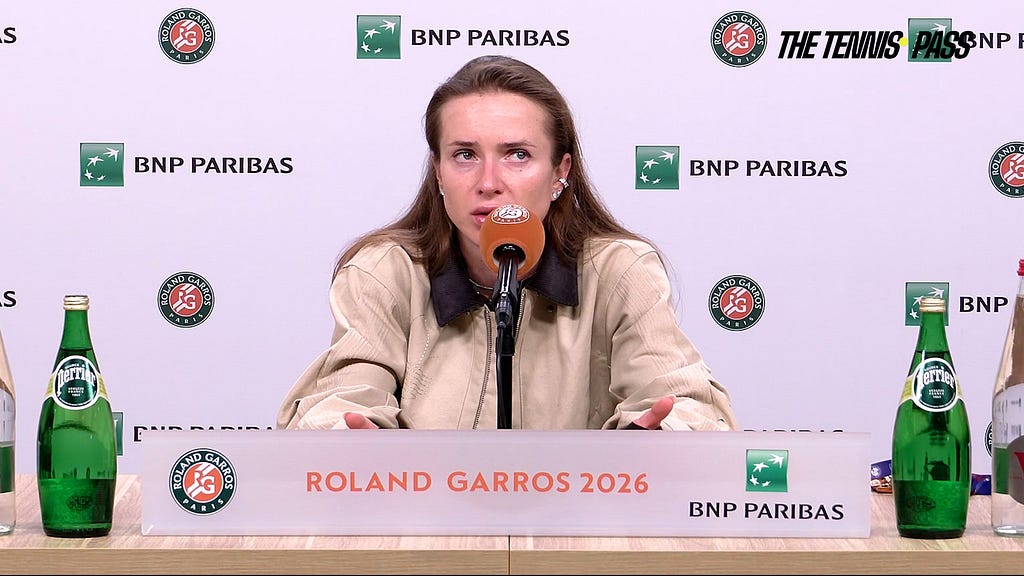
The most pointed exchanges came when the subject turned to Kostyuk’s next opponent: a Russian player.
She’s beaten this opponent twice already this year. She’s clear about how she manages it: “I usually never care who is on the other side of the net. I’m there to play tennis and do my job.”
But she was less diplomatic when asked about Russian players who deflect the political dimension entirely - saying things like “I’m just playing against the ball.” Was that frustrating?
“For me it’s not frustrating anymore. They are all grown-ups. They know what they’re talking about. They have phones, Instagram, news. They are clearly aware of what’s going on.”
She pointed to Daria Kasatkina as someone who made a different choice - who spoke publicly, whose parents were subsequently threatened by strangers coming to their apartment, and who still didn’t stop. “There is nothing that’s stopping you if this is something you don’t believe in.”
Her conclusion was blunt: “After four years, I think they’ve made it very clear whose side they are on. This is their burden to carry and this is what they live with, not me.”
When asked what it would mean for Ukraine if she wins, Kostyuk pushed back on the premise that Ukraine had underperformed athletically since the invasion began.
“We had the most representation in Olympics since Ukraine became independent. We have great high jumpers. Usyk is a legend. Tennis players are on fire right now, especially the girls.”
She spoke about Ukrainian athletes who don’t have the mobility of tennis professionals - who train in the country, live in it, compete while living inside the danger. “To be able to compete being in this situation is for me another level. I’m very proud of all of them.”
And then, with characteristic lack of sentiment: “I don’t think so far ahead. Being here is a real blessing. I’m here to represent Ukraine and to enjoy.”
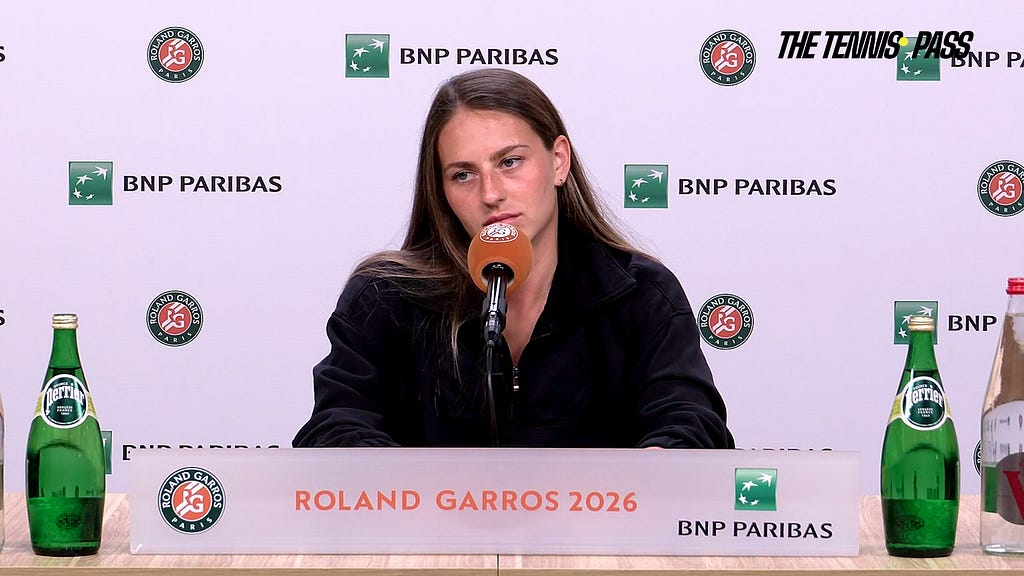
There’s a reason these press conferences land differently to the usual post-match circuits. Kostyuk doesn’t perform emotion or manage her image around it. She answers the question directly, draws the line where she thinks it should be, and moves on.
What she said about Russian players will generate debate. What she said about her family, about news notifications, about the “biggest thing I can do” - that will stay longer.
She has a semi-final on Thursday. She’s playing a Russian opponent. Seventeen wins in a row.
She’s not thinking about winning. But she’s not going anywhere either.
Watch the full press conference on The Tennis Pass.
Enjoying this story? Subscribe to The Tennis Pass on YouTube for daily tennis news, highlights and interviews.
Subscribe to The Tennis Pass on YouTube

