 Subscribe on YouTube
Subscribe on YouTube
Subscribe on YouTube
The world №1 lost 10 games in a row, fell into a “deep, deep, dark hole” - and didn’t pretend otherwise.
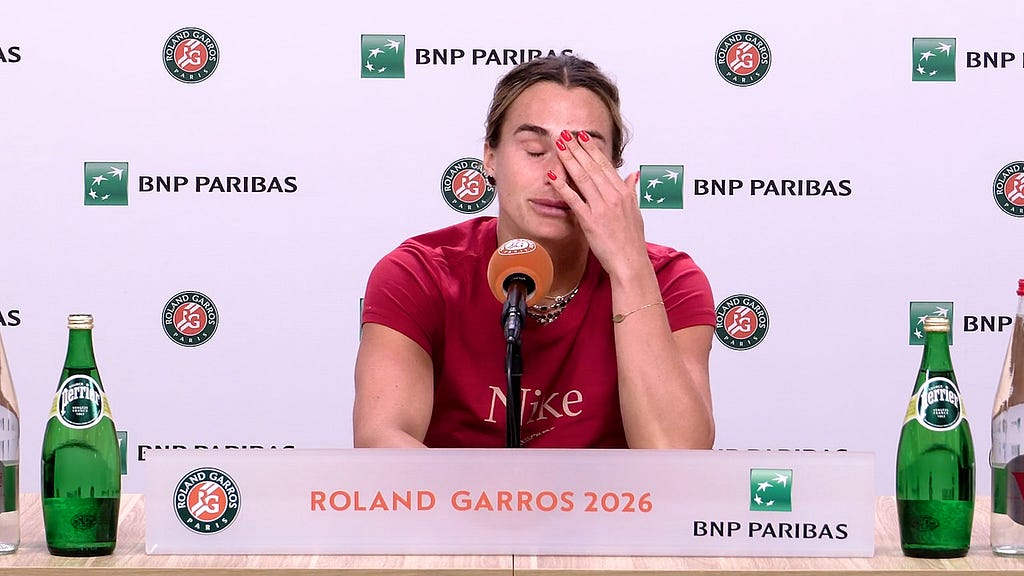
Aryna Sabalenka walked into the Roland Garros press room having just lost 10 consecutive games to exit a tournament she was widely expected to win. She was asked how she felt.
“No thoughts, no emotions. Just want to quit tennis right now.”
She let that land. Then added: “We’ll see in a few days.”
What followed was eight minutes of the kind of press conference that makes you remember why post-match interviews matter. No spin. No deflection. Just a three-time Grand Slam champion sitting with something painful and refusing to dress it up.
By any measure, what happened on Court Philippe-Chatrier was a collapse. Leading the second set, with the match apparently in hand, Sabalenka lost the plot — and then lost everything.
Her diagnosis was clear-eyed: “I feel like I had very decent opportunities in the second set. I screwed up, and then she stepped in and played great. Mentally I couldn’t really recover after her second set — I think that was the biggest mistake from me.”
The spiral that followed wasn’t about tactics. It was about what happens inside your own head when the match starts to slip and you can’t find the brake. “I got into a very deep, deep, dark hole and I just couldn’t get back mentally on track.”
When was the last time she lost 10 games in a row? She didn’t know. She couldn’t remember it happening before.
She brought up the conditions unprompted, and it was one of the sharper moments of the press conference.
The wind on Chatrier was significant. Sabalenka noted that even while winning, the tennis was “very dirty” — and she questioned why the roof stayed open. “I don’t know how people could actually sit there and watch me play.”
Her pointed observation: in a comparable situation last year, the roof was closed for the men’s matches the following day. “I don’t know why they kept it open. It was really crazy.”
She was careful not to use it as an excuse — “how can I complain if almost for the whole match everything was working okay for me?” — but she raised it clearly. She also admitted she never asked for the roof to be closed herself.
Asked why she hasn’t been able to match her dominant hard court results at Roland Garros and Wimbledon, Sabalenka gave an answer that felt genuinely unresolved.
“I feel great on clay. I feel great on grass.” She paused. “I think maybe I’m focusing too much on the fact that I’ve never won a Slam on each surface — and maybe it makes me overthink. Makes me over-emotional at some moments.”
She said it plainly: “I’m so tired of losing in not the best way, just because I was over-emotional.”
That’s a hard thing to admit publicly. The mechanics of the game aren’t the problem. The gap between what she knows she can do and what she actually does in big moments on these surfaces — that’s what she’s trying to close.
A journalist asked whether this match had similarities to last year’s Roland Garros final — another situation where a lead evaporated. Sabalenka didn’t flinch.
“That’s what I’m saying. I just have to sit back and openly think about what’s going on in my head in those tough moments. I’m a quite experienced player. I’ve been through so many things, overcome so many things. I just have to figure out that little thing that isn’t working for me sometimes.”
A pattern acknowledged. A solution still being searched for.
The press conference ended with a journalist asking about her recovery plan. Sabalenka’s first response was a long pause, then: “I honestly don’t know.”
Then she laughed — a genuine one — and offered a different kind of answer.
“You know those rooms where you just go in and smash everything? Probably I’ll spend a whole day tomorrow over there destroying stuff. Maybe it will help. Maybe not.”
It got a laugh from the room. She snorted. The tension broke.
But the line she left before that one was the one that mattered: “What doesn’t kill us makes us stronger. At some point I will figure out that little situation and I’ll only get back tougher.”
The draw at Roland Garros 2026 was as open as it gets. Sabalenka knew it. She didn’t pretend otherwise — even while pushing back on the framing slightly, noting that the players left in the draw are genuinely good. “Marta is in great shape. Mera is playing great tennis.”
She acknowledged, half-laughing, that she might have had the least favourable result of anyone still in contention. Then corrected herself mid-sentence and dissolved into laughter before she could finish the thought.
That moment — trying to be diplomatic, losing the thread, laughing at herself — was the most Sabalenka moment of the whole press conference.
She’s the world №1. She just lost 10 games in a row at a Slam she desperately wants to win. She told the room she wanted to quit, and she told them she’d be back.
Both things feel true.
Watch the full press conference on The Tennis Pass.
Enjoying this story? Subscribe to The Tennis Pass on YouTube for daily tennis news, highlights and interviews.
Subscribe to The Tennis Pass on YouTube

